

Reports
AI for PO Exception Management
How leading manufacturers turn supplier email into clean, real-time ERP data
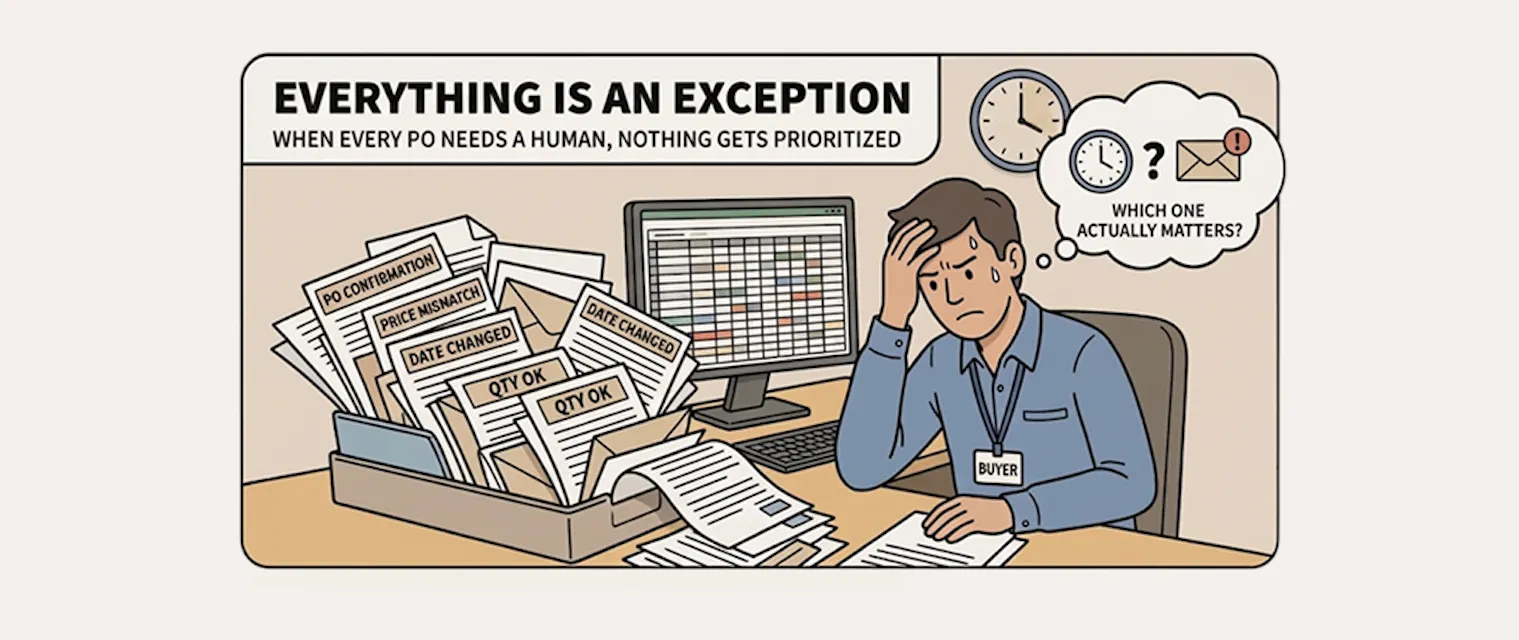

Leading manufacturers are leveraging AI agents to manage by exception. By updating the ERP as soon as a supplier communicates a change, they turn what was a reactive, manual process into a proactive, automated one. The results are consistent: fewer manual touchpoints, faster confirmation cycles, measurable improvements in fill rate and supplier OTIF, and fewer exceptions driving high expedites and excess safety stock. Here is what this looks like in practice for manufacturers:
| Company | Industry | Use Case | Impact |
|---|---|---|---|
| Package One Industries | Packaging | AI extracts supplier acknowledgments and ship-date changes from email and PDF and alerts planners in real time; replace reactive backorder management. | 90% reduction in PO confirmation time; downstream commitments protected through earlier intervention. |
| Hussmann | Refrigeration Systems | Connected cold-chain asset tracking and automated warehouse / maintenance response coordination; calculates downstream fulfillment SLAs and triggers maintenance requests. | 98% of supply chain signals resolved automatically. |
| Schneider Electric | Energy Management & Industrial | Specialized autonomous planning agents detect data pipeline. exceptions and stock deviations; agents execute an automatic RCA protocol and trigger auto-replenishment. | 10% overall inventory decrease; 15% yield improvement on specific manufacturing lines. |
| teamtechnik | Industrial Automation & Assembly Systems | Processes order confirmations, shipping notices, and invoices; flags deviations with automated warning systems. | Optimized a 19-person team managing 80,000 purchasing positions per year. |
| WITTENSTEIN SE | Electromechanical Drive Technology | PO confirmations from email and PDF automatically captured, matched against SAP purchase orders; deviations flagged, matched confirmations auto-posted. | 94% PO acknowledgment rate; 30% boost in supplier OTIF to 90%. |
Every purchase order follows an expected path. The buyer issues it, the supplier confirms quantity and date, the goods ship on the committed date, and the receipt and invoice reconcile against what was agreed. When a PO runs clean from end to end, no one needs to intervene.
An exception is any point where this path deviates. The supplier confirms a date two weeks later than requested. They acknowledge a partial quantity or split the line across two shipments. They go silent past the acknowledgment window. A date that held at first slips. A part gets substituted. In each case, the supplier's actual position deviates from the plan the buyer is working against.
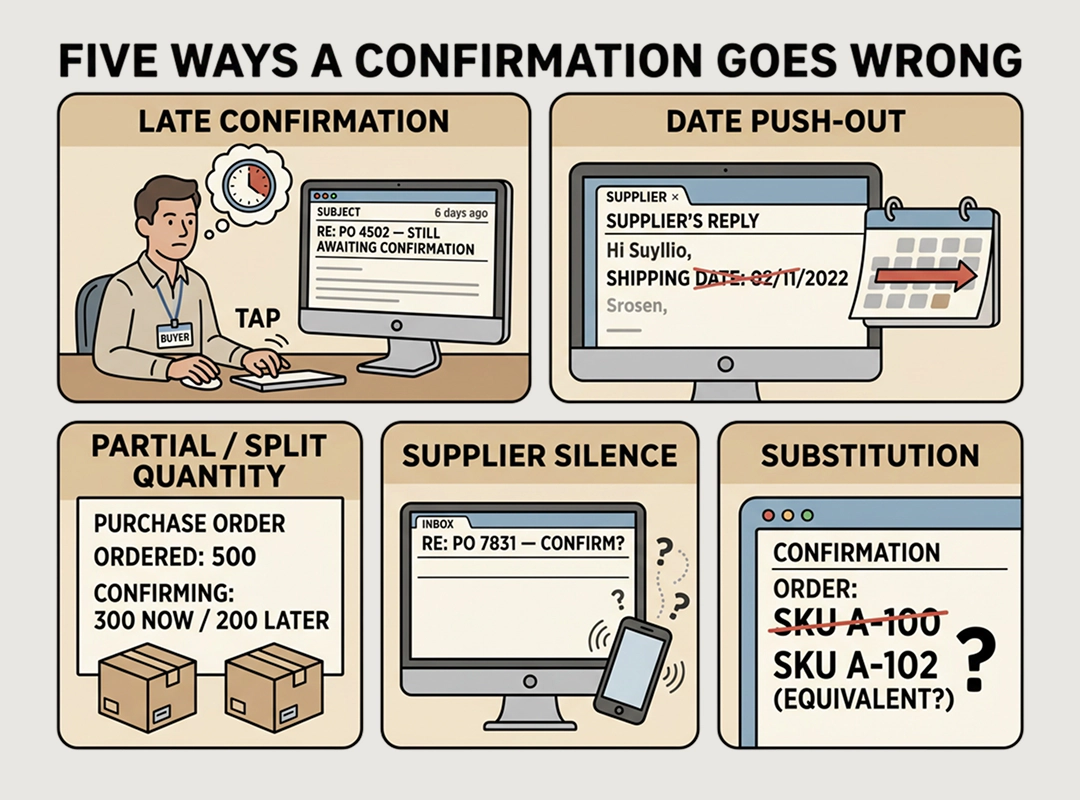
Exception management allows buyers to catch these deviations early, decide which ones matter, and resolve them before they affect production. A late confirmation on a low-value indirect part is noise. The same delay on a component feeding a production line is a line-down risk that a planner should manage today.
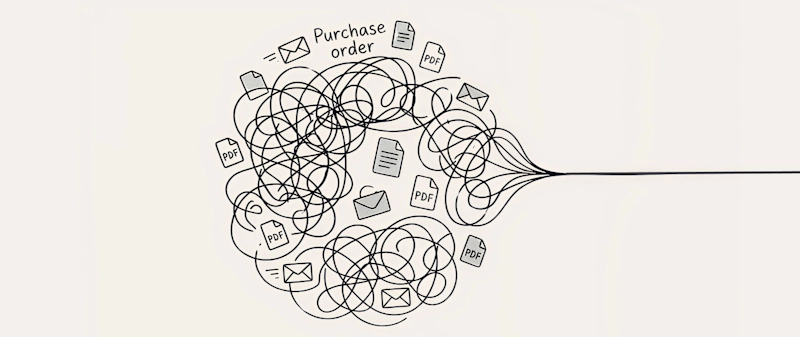
The ERP holds the expected state of every order. But the deviation arrives in a supplier's reply or a PDF order confirmation or a forwarded note from a sales rep. 90% of PO confirmations still come back by email. EDI only covers strategic partners, supplier portals cover a fraction, and email covers everyone else. So before a planner can manage an exception, someone has to read the message, interpret it, find the matching PO, and update the system manually. That is where confirmation data goes stale, and where the time to act disappears.
This is the communication blind spot an AI agent closes. By integrating into the email inbox, it reads supplier replies and attachments as they arrive, extracts the confirmed quantities, prices, and dates, and matches them against the open PO in SAP or the ERP. Deviations get classified by their impact and routed to the planner who owns the downstream commitment, with the context already attached. This way, the order lifecycle stops depending on a person noticing the right email in time.
Most supply chain executives from manufacturing companies we speak with point to the same three outcomes.
| Cost Area | Before | After | Impact |
|---|---|---|---|
| People Overhead / FTEs on confirmation work | 30 FTEs / $1.9M annual cost | 9 FTEs / $1.0M annual cost | $900K saved / 70% reduction |
| Expedites & Safety Stock / Confirmation-driven delays | $3.4M annual cost | $1.2M annual cost | $2.2M saved 65% reduction |
| Supplier OTIF / On-time, in-full delivery | 84% OTIF | 91% OTIF | +7 points |
| Total Annual Savings | $3.1M |
Unlike traditional software projects, an AI Agent does not require upfront data cleaning, 12-month global rollout, or supplier onboarding. A pilot can start with one procurement team and their highest-volume supplier segment, with minimal IT resources.
The AI Agent connects to the organization's existing email environment and ERP through a lightweight integration. It is like adding a new team member who understands the organization's standard operating procedures and starts working. Suppliers keep doing exactly what they do today. Procurement teams and planners keep using the same inbox. The manual work in between is handled by the AI Agent.
Organizations can prove ROI within the first eight weeks with a single team and use the results to build the business case for a broader rollout.
You just read where teams are automating. We will show you the same on your documents, in 30 minutes.