
Reports
How Wholesale Distributors Leverage AI for PO Automation
Why EDI and portals leave most supplier communication unstructured - and how AI Agents turn email into real-time ERP data

A distributor's and wholesaler's supply chain runs on two communication channels:
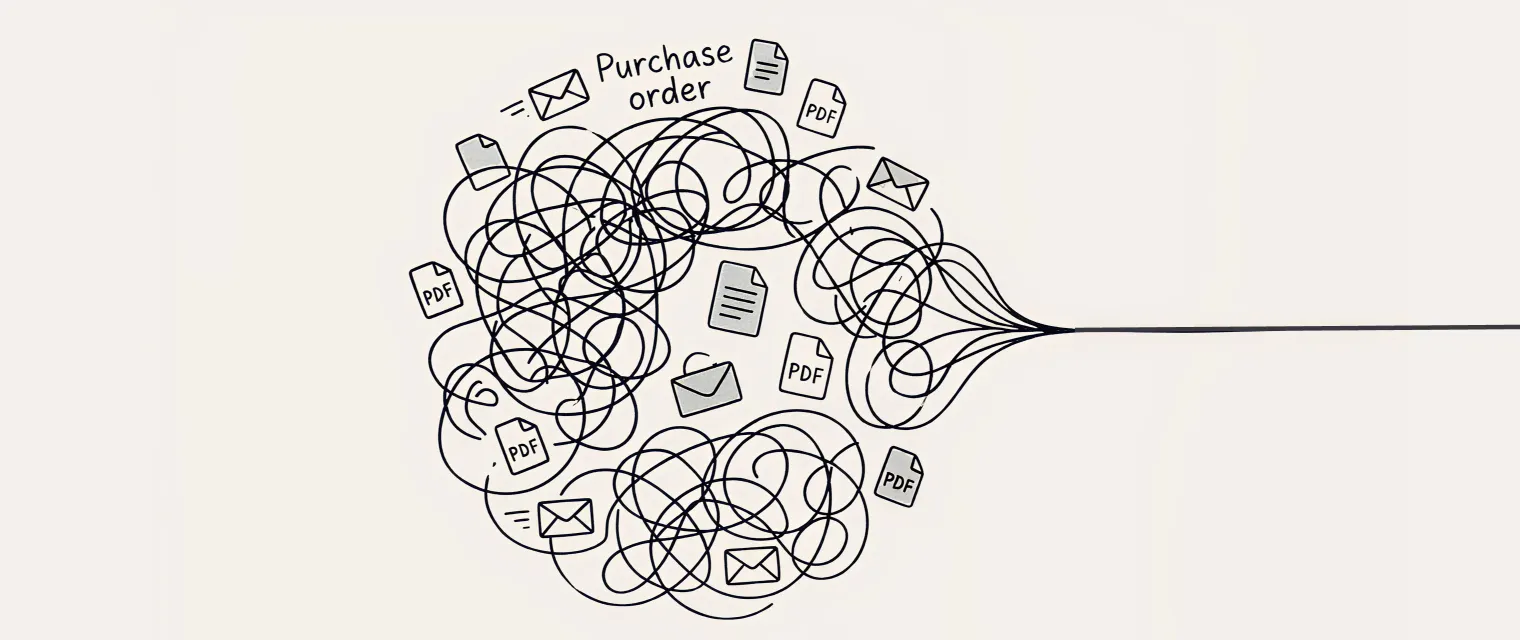
Both run predominantly by email, and in both cases critical information sits in unstructured messages, invisible to the people who need to act on it. Unlike a manufacturer, a distributor absorbs risk from both ends. The service level failure belongs to the distributor, not the supplier. Most cover the uncertainty with extra safety stock, and in distribution those carrying costs come straight out of margin.
Despite modern ERP and replenishment systems, most distributors and wholesalers hit the same wall when collaborating with suppliers. The most common industry options are:
1. EDI, which is often reserved for strategic partners because it is costly and time-consuming to implement and maintain.
2. Supplier portals, which only work when the buyer has enough leverage to mandate adoption.
In practice, Email remains the channel for PO confirmations, promised dates, and escalations that arrive as text bodies, PDFs, Excel attachments, and everything in between. The downstream cost shows up in three places:
1. Human capital expense. Teams spend their days communicating with suppliers, validating information, and manually transferring confirmation data into the ERP.
2. Missed signals for replenishment planners. Critical updates and exceptions sit in unstructured emails. The delivery dates in the ERP no longer reflect reality, and replenishment planners make stocking decisions based on what suppliers committed to, not what they will actually deliver.
3. Costs from reactive firefighting. A missed confirmation or slipped date triggers a familiar sequence: a spot buy at higher cost, expedites to protect customer commitments, and a service level failure that, repeated often enough, moves the customer to a competitor. The real cost is the margin on every reorder Companies now have a new option: Agentic AI can solve this without requiring suppliers or internal teams to change anything they do today, without a new portal, a new workflow, or a large IT project to push EDI across the supplier base.
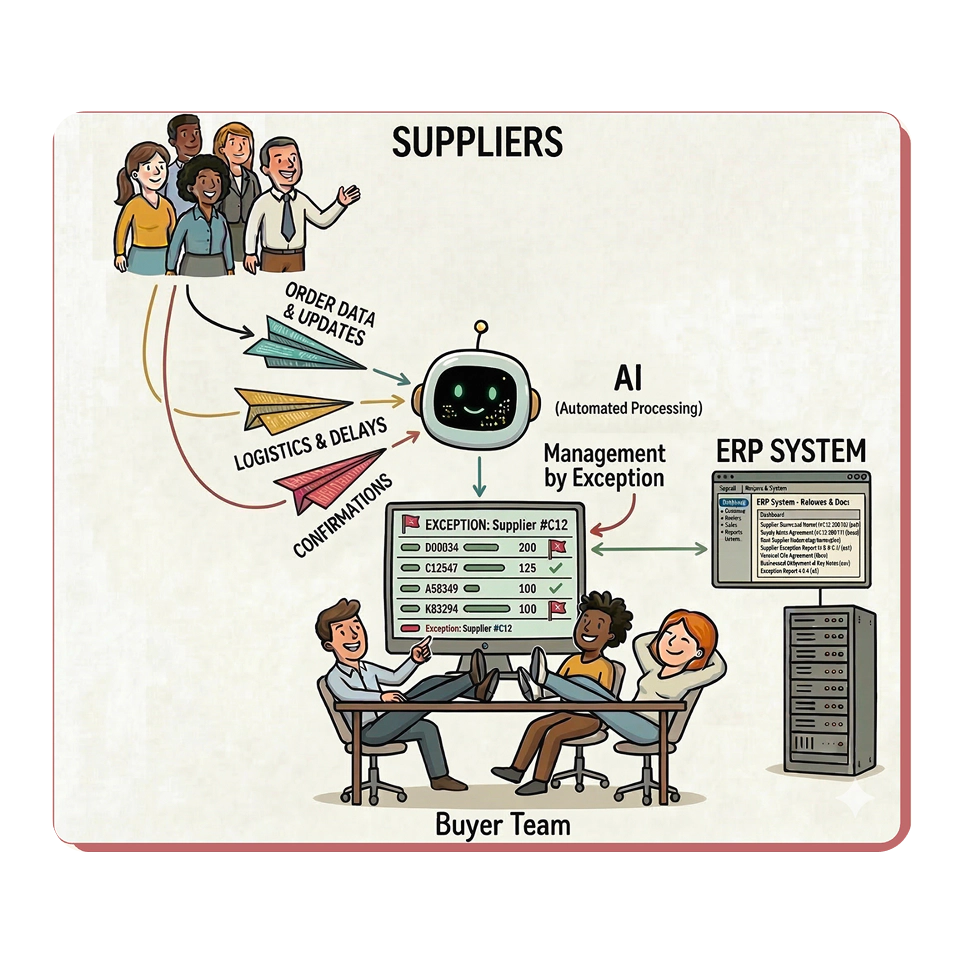
AI Agents work inside the email channels that purchasing teams already use to communicate with suppliers. They read unstructured confirmations in any format, validate against master data and the original PO, follow up with suppliers autonomously, and keep the ERP current in real time. Replenishment planners work from accurate data, and exceptions surface before they become stockouts.
This report covers why EDI and portal adoption stalls in practice, what running this process manually actually costs for distributors and wholesalers, and how an AI Agent turns unstructured supplier communication into structured ERP data.
Leading distributors and wholesalers are automating PO confirmation processing, connecting supplier communication directly to the ERP in real time. The results are consistent: fewer manual touchpoints, faster confirmation cycles, measurable improvements in fill rate and supplier OTIF, and fewer exceptions driving high spot-buy costs and excess safety stock.
| Company | Industry | Use Case | Impact |
|---|---|---|---|
| Ferguson PLC | Plumbing, HVAC & Industrial Wholesale | Eliminate manual-entry error as a source of supplier OTIF misses: AI validates supplier confirmations against the original PO and master data before they enter the ERP, removing a major cause of inbound exceptions. | 26% lift in OTIF fulfillment 50% fewer order errors |
| Congebec Inc Food | Wholesale & Cold-chain Distributor | Document verification and exception flagging: AI processes incoming supplier confirmations, packing slips, and shipping documents against the original PO, flagging weight, date, and quantity inconsistencies before they cause spoilage. | 94% reduction in manual document entry time; inconsistencies flagged pre-arrival, preserving perishable margins |
| Wolseley Utilities | Plumbing, HVAC & Waterworks Distribution | Shift procurement from a chase-andconfirm model to manage-byexception. AI handles routine acknowledgments end-to-end without buyer touch and escalates only true exceptions. | 92% of POs confirmed within 48 hours; purchasing team redirected to category management and strategic sourcing |
| Package One Industries | Industrial Packaging Distribution | Replace reactive backorder management with proactive supplier alerting: AI extracts supplier acknowledgments and ship-date changes from email and PDF, alerting buyers in real time. | 90% reduction in PO confirmation time; downstream commitments protected through earlier intervention |
| Source Atlantic | Industrial Wholesale & MRO Distribution | Automate PO confirmation and change management across ~15,000 SKUs and 100+ suppliers, replacing manual tracking through spreadsheets and email. | 94% PO acknowledgment rate and supplier OTIF lifted to 90% |
The sentiment from distribution and wholesale leaders is consistent: supplier portals were built for a world where the buyer has enough leverage to force adoption. In manufacturing, a large OEM can tell its suppliers to use a portal or risk losing the business. Most distributors don't have that leverage. In many cases, they are the ones required to log into supplier portals to retrieve confirmations.
When your supplier is a large manufacturer, be it a major CPG brand, an industrial equipment maker, or a global chemicals company, they serve hundreds of distributors. They are not logging into each distributor's portal to manually update information for one account. The power dynamic runs the other way.
Walk the floor and the evidence is there: buyers are still manually copying and pasting updates from Outlook into the ERP. Suppliers continue to confirm POs and communicate exceptions by email. Replenishment systems remain unaware of critical signals buried in those emails, signals that the ERP never sees.
At one large distributor we spoke with, fewer than 5% of their suppliers actively used the portal. Another integrated SAP Ariba to standardize confirmations for key categories, then scaled it back after teams reverted to email the moment exceptions arose.
So the status quo is this: EDI handles the strategic partners, portals handle a fraction of the rest, and email handles everyone else. It’s the one channel that works for every customer, handles routine confirmations and complex exceptions equally well, and requires nothing from either side. In practice, that is more than half of the confirmation volume and over 90% of all suppliers.
Every distribution leader we speak with recognizes this. Email is the dominant channel. The real question is what to do about it.
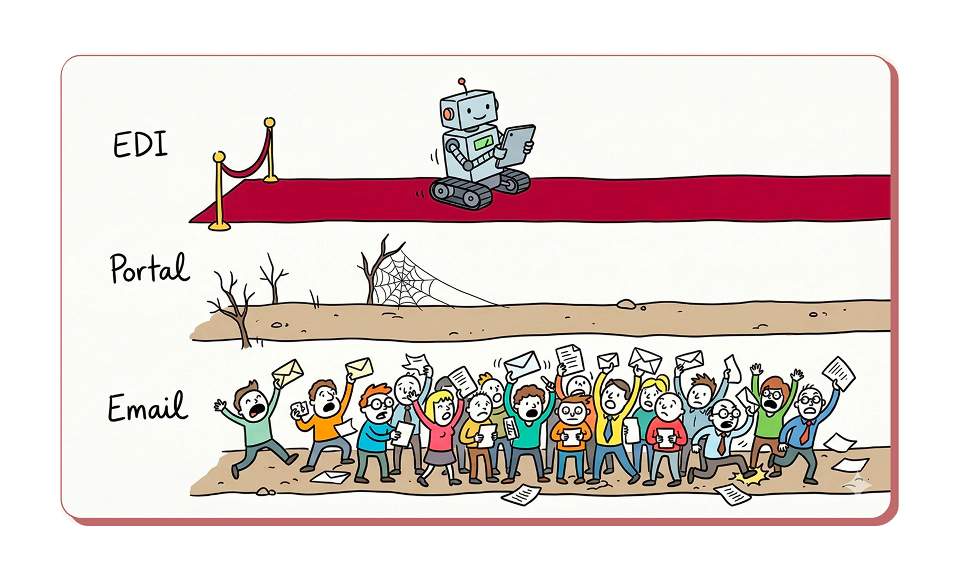
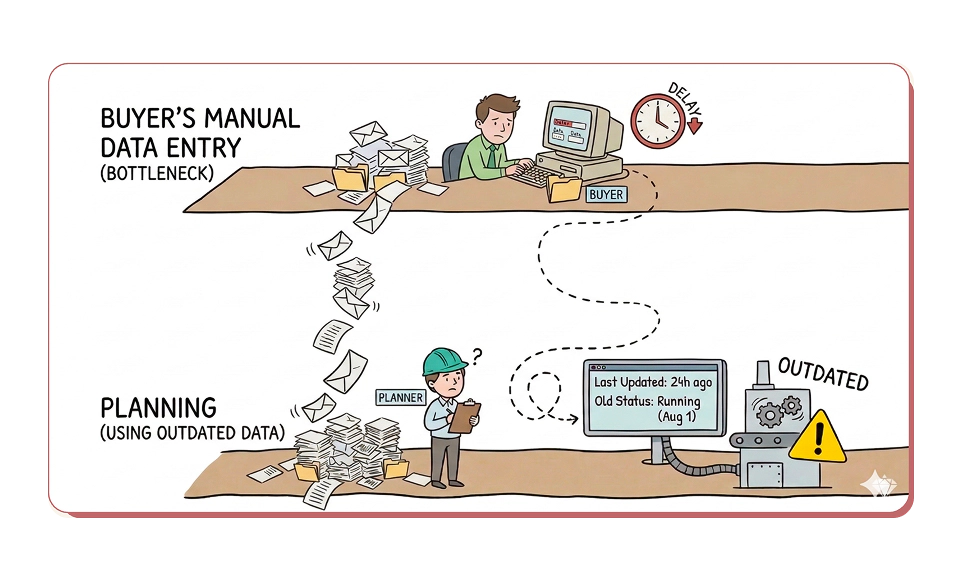
If EDI is reserved for strategic partners and portals have minimal adoption, email is the de facto standard to issue POs to suppliers and collaborate with them on promised dates and exceptions. Critical information arrives unstructured in mail bodies, or deeply embedded inside PDFs and Excel attachments. Every confirmation requires a buyer to read the email, interpret the response, cross-reference it against the original PO, and manually key the data into the ERP. Until that happens, planners are working with outdated information. Most organizations accept this as operational reality. Few have quantified what it actually costs.
1. Human Capital Expense
PO confirmation-related activities frequently account for 60 to 70% of a buyer's workload: managing incoming confirmations (30%), updating the ERP (20%), and resolving exceptions and escalations (20%), according to a recent report published by APQC.
At a $1.4B specialty distributor processing roughly 44,000 POs per year, the purchasing team managing confirmations required 26 FTEs, costing close to $1.7M in fully loaded salaries. A best-in-class organization of similar size would operate with about 8, with buyers handling roughly 460 POs per month versus 140 in the example above, according to APQC. This would decrease the human capital expense alone by roughly 49%.
2. Downstream errors and expensive corrections
When critical data about confirmations or delays sits in unstructured emails, it takes buyers hours of effort to context switch, parse the information, and keep the ERP system up to date. The delay between supplier communication and updated information in the ERP is typically two to five days. During that window, the organization loses valuable time to react, respond, and adjust to new signals and instead works off bad data.
To address this, organizations typically take one of two approaches.
3. The Impact on Customer Fill Rate and OTIF
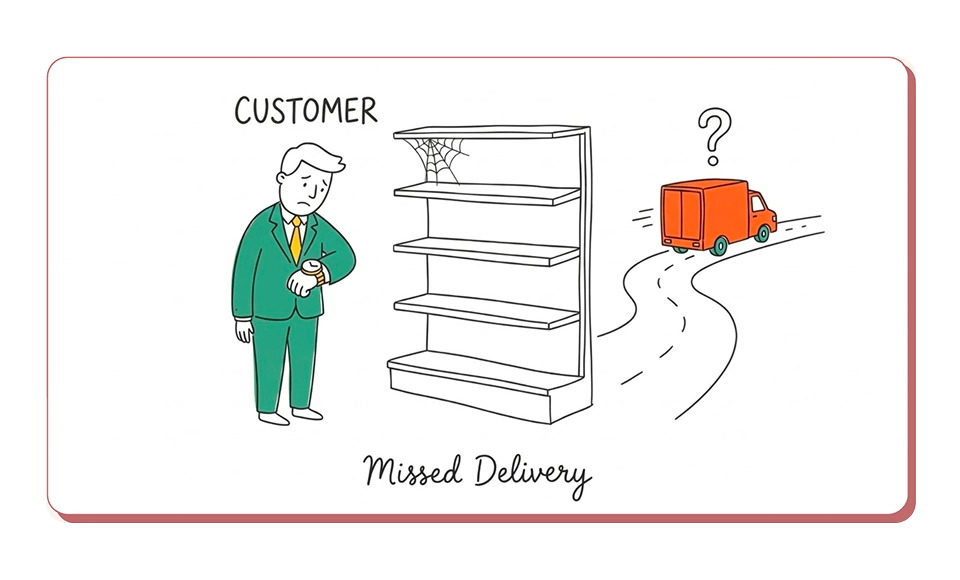
Wholesale distributors track customer fill rate and OTIF as top-line KPIs, but the cost of seeing them drop is less frequently quantified. When an unprocessed confirmation delays a replenishment cycle, the distributor pays for spot buys and expedites internally. The customer receives the backorder notification.
A stockout costs more than the expedite. It costs the margin on every reorder that no longer comes back.
Supplier confirmations have always lived in email: delivery dates, exceptions, price changes, all in mail bodies and PDF attachments.
An AI Agent that operates inside the same inbox buyers already use meets suppliers where they are. It requires no portal, login, or workflow change from them. The agent reads, validates against master data, updates the ERP in real time, and surfaces only the exceptions worth a buyer's attention.
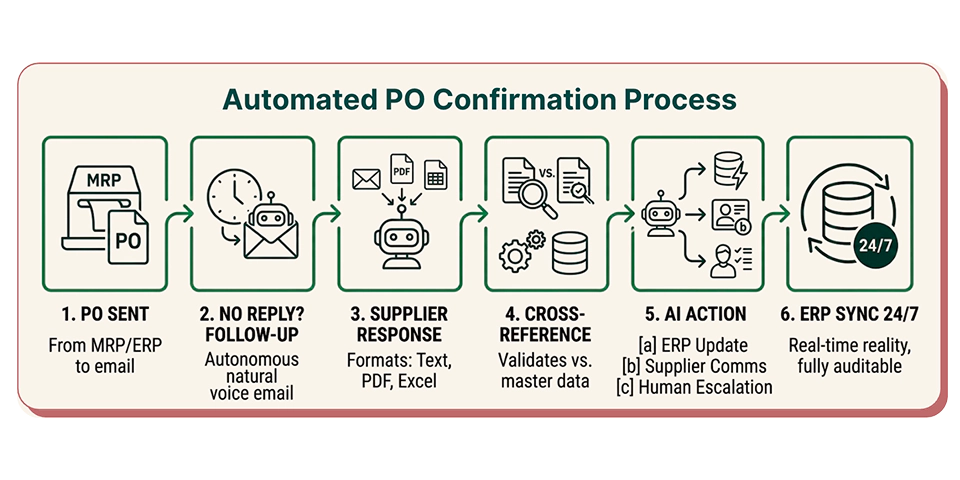
| Step | What Happens |
|---|---|
| 1. PO sent from replenishment or purchasing system | The PO is sent from the ERP or replenishment system. The AI Agent receives emails from the purchasing group mailbox or integrates with the organization's email system via forwarding rules. |
| 2. No reply? AI follows up | If the supplier hasn't responded within the agreed SLA, the AI follows up autonomously in a natural and professional human voice via email. |
| 3. Supplier replies by email | Suppliers confirm via text, Excel, PDF, or other means, ask questions, or propose changes to the PO. No process change required of them. |
| 4. AI reads, validates, and cross-references | The AI Agent cross-references the supplier's response against the original PO from the ERP. It flags mismatches and validates against the master data. |
| 5. AI takes action | The purchasing team now only manages by exception: (a) If there are no issues, the AI automatically updates the ERP. (b) If the AI spots inconsistencies, it reaches out to the supplier to clarify, verify, and confirm. (c) Only exceptions that require human intervention are escalated to the buyer for one-click approval. |
| 6. ERP stays in sync, 24/7 | The ERP now reflects reality. Replenishment planners can make decisions based on actual supplier commitments instead of old promised dates. Every update is fully auditable. |
The AI Agent is configured around the organization's SOPs and business rules. No data leaves the environment. Every action is logged with a full audit trail, and the purchasing team controls what the AI Agent can and cannot do.
When a discrepancy cannot be resolved with the supplier directly, the AI Agent recommends solutions and next steps to the buyer. The buyer can either approve the recommendation or work with the AI Agent to explore alternatives. Once a path is confirmed, the AI Agent executes based on the organization's SOPs. The buyer stays in control; the AI handles the execution.
Beyond forecasts and reports, the organization's replenishment process runs on live signals. New information triggers immediate action.
The AI Agent is designed around three principles. First, every confirmation is validated against the organization's master data and the original PO before anything is updated in the ERP or sent back to the supplier. Second, the AI Agent communicates in clear, professional language that mirrors how the purchasing team already writes. Third, buyers retain full control.
The AI Agent does not negotiate, escalate disputes, or make commitments on behalf of the buyer. When something falls outside the standard flow, it escalates with full context so the buyer can engage the supplier directly.
In practice, suppliers often respond faster and more consistently when the follow-up cadence is quick and reliable.
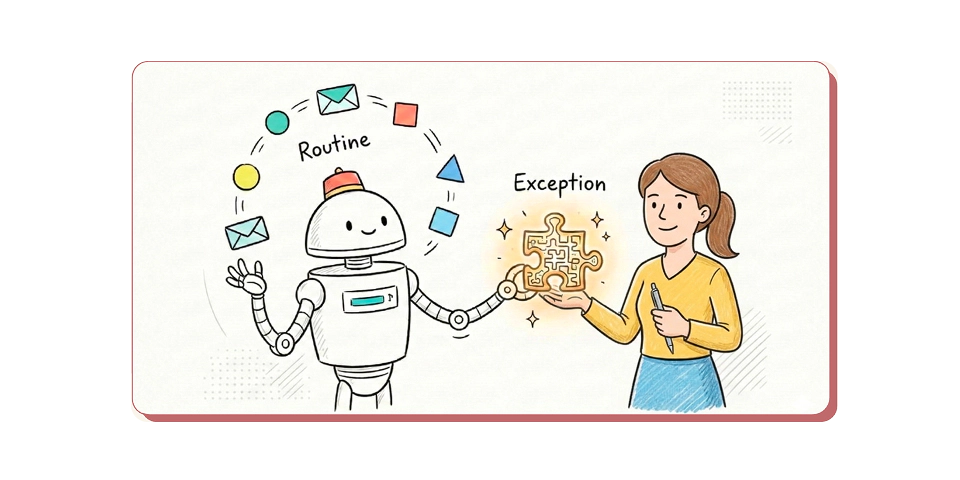
Most distributors and wholesale leaders we speak with point to the same three outcomes.
| Impact Area | Before Implementation | After Implementation | Savings |
|---|---|---|---|
| Procurement Operations Overhead | 26 FTEs / $1.7M annual cost | 8 FTEs / $870k annual cost | $830K saved / 49% reduction |
| Spot Buy Premiums and Inventory Carrying Costs | $3.2M annual cost | $1.1M annual cost | $2.1M saved / 66% reduction |
| Customer Fill Rate | 93% | 97% | +4 points |
| Total Annual Savings | $2.9M |
Unlike traditional software projects, an AI Agent does not require upfront data cleaning, 12- month global rollout, or supplier onboarding. A pilot can start with one purchasing team and their highest-volume supplier segment, with minimal IT resources.
The AI Agent connects to the organization's existing email environment and ERP through a lightweight integration. It is like adding a new team member who understands the organization's standard operating procedures and starts working. Suppliers keep doing exactly what they do today and buyers keep using the same inbox. The manual work in between is handled by the AI Agent.
Organizations can prove ROI within the first eight weeks with a single purchasing team and use the results to build the business case for a broader rollout.
You just read where teams are automating. We will show you the same on your documents, in 30 minutes.